Amodei rejects claims Anthropic wants AI to govern society
Anthropic CEO Dario Amodei called claims that his company wants AI to govern society "absurd," arguing he has long backed democratic oversight. He also accused rivals of "vibes-based" positioning while his own company leans harder on AI-written code.
The rebuttal
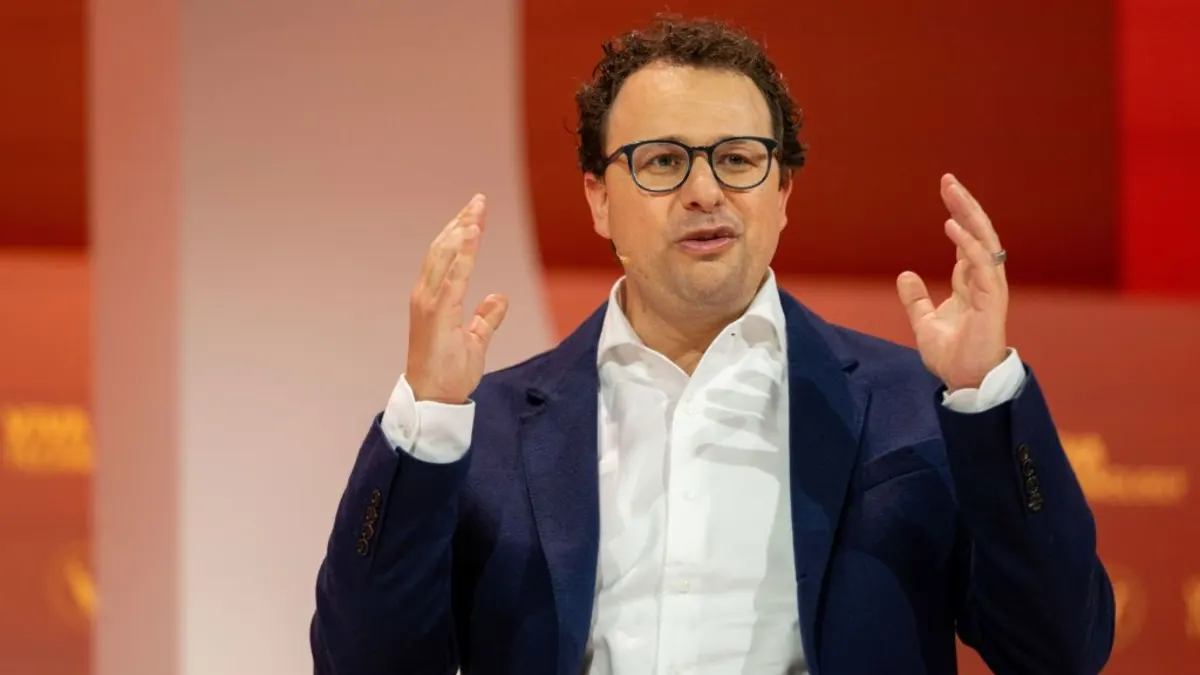
Dario Amodei doesn't want anyone to think Anthropic is asking people to hand their free will to machines. In a long post on X on Wednesday, the Anthropic CEO called that idea "absurd." He wrote that legitimacy and self-determination should never be sacrificed "at the altar of efficiency or security," and that his argument against autocracy applies word for word against governance by AI.
Rivals raise the stakes
The post didn't come out of nowhere. Rivals have been talking more loudly about human agency. Earlier this month, OpenAI CEO Sam Altman said he wanted people to keep "agency over the future." Meta's chief AI officer Alexandr Wang wrote on X that we "should not be okay with a 'handover' of society to AI." Wang also said it's hard to imagine humanity keeping control over fully unconstrained recursive self-improvement.
Amodei's defense rests on his earlier writing. He says he has repeatedly argued for democratic oversight, that AI should strengthen democratic institutions, and that humans should keep ultimate decision-making power. His line is that anyone who read his essays and interviews carefully couldn't reasonably conclude otherwise.
Automation versus surrender
He also drew a distinction that matters for how the argument gets read. Giving up free will broadly is one thing. Letting AI take on specific tasks in a more automated way is another. His examples were AI driving a car, designing a cancer drug, or writing software end to end. That's a narrower claim, and it's the one most businesses actually deal with day to day.
Drawing the line at RSI
Where he does want a line is recursive self-improvement, or RSI: AI that improves itself without human help. Many safety experts see RSI as a path to losing control, and Amodei seemed to accept some of that, writing that "we may want limits on this process."
Closing the loop
Here the picture gets complicated. Anthropic is building toward RSI-like workflows in its own shop. The company said in June that Claude wrote more than 80% of the code merged into its codebase. METR, an AI safety research nonprofit, published an assessment this month finding Anthropic's models are improving at roughly twice their historical rate, mostly because of AI-assisted research. And Anthropic's own IPO filings describe each Claude generation speeding up the next, a process the company calls "closing the loop."
The supervision problem
Amodei addressed that tension directly. As Anthropic said publicly in early November, he wrote, it doesn't expect it to be safe for Claude to build successive frontier models fully autonomously, "without meaningful human supervision or understanding." The weak spot is that phrase. AI is already moving faster than engineers and safety experts can fully audit, which leaves them leaning on other AI systems to act as judge and jury. Deceptive behavior makes it worse, especially when models recognize they're being evaluated.
Anthropic isn't alone in this race. This week OpenAI claimed it had solved a major open problem in computer science: the exact speed limit of matrix multiplication, the mathematical engine under deep learning and physics simulations. Nobody in the field is standing still.
Calling out the competition
That's the heart of Amodei's counterattack. He accused competitors of "vibes-based commercial and political positioning," saying they toss around phrases like "human control and agency" or "AI should just be a tool" without running the race any differently. In his words, the products rivals offer don't differ materially in their orientation toward task automation. Every company, he said, claims to understand the risks and to offer safeguards.
Both sides have a point
So both sides have a point, and neither is fully clean. Rivals can fairly ask how much supervision is meaningful when AI writes most of the code. Amodei can fairly say the competing messaging hasn't changed what anyone ships. For buyers, the useful signal isn't the rhetoric. It's what each lab does about oversight, as the pace of automation climbs.
Amodei's line between automating tasks and surrendering control is reasonable, and it matches how most of our clients would use AI. But the 80% figure and the "closing the loop" language show how hard meaningful supervision gets. If you're picking a vendor, watch what they do about audits and oversight, not what they post.
- 01Amodei called the claim that Anthropic wants humans to surrender free will "absurd" in an X post on Wednesday.
- 02He suggested limits on recursive self-improvement, saying "we may want limits on this process."
- 03Claude wrote more than 80% of merged code at Anthropic as of June, and METR says its models improve at about twice their historical rate.
- 04He accused rivals of "vibes-based commercial and political positioning" on human control.
Every major lab is pushing task automation, so safety claims alone won't tell you much about a vendor. Companies buying AI should ask how each provider handles human oversight in practice.
+Talk about your use caseSummary written by Neuvilabs from public reporting. Facts belong to the original sources linked above.
 IndustryMarket Watch
OpenAI countersues Apple over trade secrets and pressure on shared suppliers
OpenAI sued Apple in California, alleging trade secret theft, unfair practices and coercion of shared suppliers. It follows Apple's summer suit over leaks to OpenAI and a $6.4 billion hardware push.
 IndustryMarket Watch
Nvidia's board reverses Jensen Huang's resignation, returning him as CEO
Nvidia's board reversed Jensen Huang's resignation, and a SiliconANGLE column says markets mostly shrugged. Meanwhile CrowdStrike's $43.9 billion Zscaler deal dominated a week of mixed AI earnings.
 IndustryAnalysis
Sakana AI's CEO says homegrown models are about industry, not just security
Sakana AI will start training its own foundation model, Sawara, this month, with a small version due in early 2027. CEO David Ha says the aim is Japanese industry and manufacturing, with security needs as the nearer-term driver.