Z.ai releases GLM-5.4, a 750B Loop Transformer
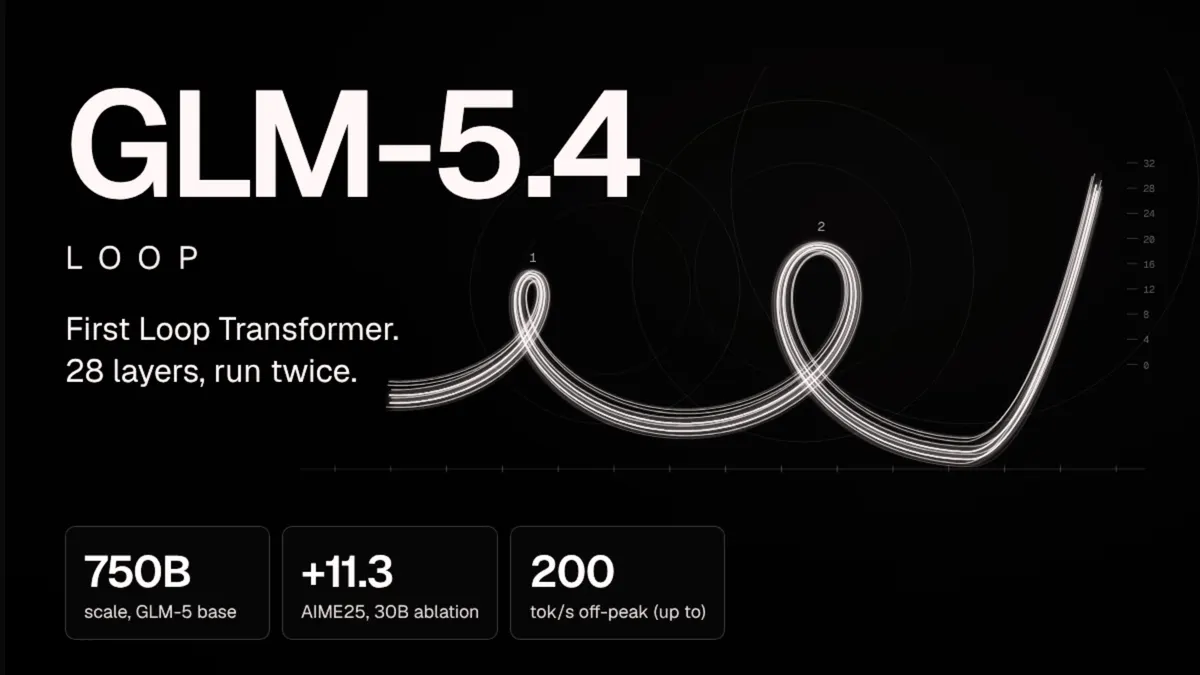
Z.ai has released GLM-5.4, a 750B-scale Loop Transformer that runs 28 GLM-5 layers twice and is said to match 2T-3T parameter models. The only hard numbers come from a self-reported 30B ablation, and the flagship has no benchmark table, API or weights yet.
What Z.ai actually built
Z.ai's new flagship, GLM-5.4, runs the same 28 layers twice. That's the core idea. The model is a 750B-scale Loop Transformer, and the company says it reaches intelligence comparable to 2T-3T parameter models. If that holds, it makes a case for getting more out of existing weights instead of stacking on new ones. The catch is the "if." Z.ai hasn't published a benchmark table for the flagship, so the headline claim rests on the company's word and on a smaller experiment. Both deserve a careful look before anyone budgets around them.
The build choice is a practical one. Z.ai didn't pre-train a looped model from scratch. It took the pre-trained GLM-5 base and adapted it through continued training. Its technical post argues that looped models trained from scratch still trail unshared models at equal compute, while adapting an existing base raises the ceiling at a relatively small compute overhead. That's a sober reading of where the technique stands today. It also means the work builds on a prior investment instead of replacing it. Z.ai says it validated the design on 1B, 4B, 30B and 750B bases, which at least shows the idea wasn't tried at a single size.
How the second loop stays affordable
Looping a model isn't free, and Z.ai made three changes to keep it workable at this scale. The first is gated progressive updates. Overwriting hidden states across loops made activation norms blow up, so GLM-5.4 adds independent per-token gates for each iteration. The first pass writes small updates and builds global context. The second pass opens the gates to refine the output. On harder tokens, the first pass writes more aggressively. In plain terms, the model spends its two passes differently depending on how hard the token is.
The second change is a hybrid KV cache. A naive design keeps a full KV cache for every loop, and at long context that gets expensive fast. In GLM-5.4, the second loop reuses the sparse KV selected in pass 1 and keeps its own new KV only inside a local sliding window. So the extra loop costs one sliding window of KV cache, not a full context cache. Z.ai says this keeps the cost increase over GLM-5.3 under control at 1M context. The third change is index reuse: the second loop takes the indices from the first loop's indexer, which adds zero indexing overhead. Z.ai reports near-identical results compared with recomputing indices on every pass.
What the numbers show, and what they don't
Now the evidence. The blog's support is an iso-parameter ablation on a 30B model that shares the 750B base's architecture. The looped version used about 10% more total training compute. Scores were measured after 200K long-context SFT with thinking mode on. Everything is self-reported, and none of it comes from the 750B flagship. A Z.ai team member said scores will come later, per DataCamp. So the 2T-3T parameter comparison has no flagship table behind it yet, and readers should hold it as a claim, not a result.
Inside the ablation, the spread is wide. The best result is AIME25, up 11.3 points, from 19.17 to 30.42. The smallest gain is IFBench, up 3.3 points, from 50.20 to 53.47. The largest gains land in math, science reasoning and long context. Output length also drops on most tasks: MMLU-Pro answers got 14.9% shorter and GPQA-Diamond answers 11.7% shorter. Z.ai says part of the reasoning moves into the loop's implicit depth. AIME25 is the exception, with output length down only 2%. Z.ai also flags "marathon thinking" loops, which it counts as a weakness.
Generalized Coding and access
On the product side, Z.ai pitches what it calls Generalized Coding: code as the tool for video, games, 3D shaders and CAD. It shows four demos. One is a self-narrated music video called "Hello World." Another is a 6-axis robotic arm built through CAD modeling in FreeCAD. The third is a complete game with movement, physics, maps, combat and art assets, and the fourth is an interactive bird-watching scene built with math geometry and custom GLSL shaders. These are vendor demos, not benchmarks. They show range. They don't show reliability.
Access is narrow for now. GLM-5.4 ships first inside Z.ai's own products: the GLM Coding Plan, the ZCode desktop app and Z.ai Chat. ZCode is the company's desktop agent app for the model and runs on macOS, Windows and Linux (Beta). The Coding Plan lists Lite at $12.6 a month, Pro at $56 and Max at $117.6, and Z.ai says prices may change. Speed is reported at up to 200 tokens/s off-peak and 70-80 tokens/s at peak load, helped by fused core kernels that cut intermediate memory traffic.
What's still missing
A lot is still blank. Active parameters aren't disclosed. The context window isn't officially listed, though the blog discusses deployment at 1M context. There's no public API or weights yet, and self-hosting hardware needs stay unknown until weights ship. Anyone comparing open frontier models has little to compare against today. The architecture idea is interesting and the 30B ablation is encouraging. The flagship claim stays unproven until Z.ai posts the scores it has promised.
We'd try it in ZCode on a real coding task, since the entry price is low, but we wouldn't treat the 2T-3T claim as settled. Teams already on GLM models should care most, because the looped design builds on the GLM-5 base. The thing to watch is the flagship benchmark table, plus whether the "marathon thinking" loops show up in daily use.
- 01GLM-5.4 runs 28 weight-shared GLM-5 layers for 2 iterations at 750B scale.
- 02In a 30B ablation, AIME25 rose 11.3 points (19.17 to 30.42) for about 10% more training compute.
- 03The extra loop costs one sliding window of KV cache; speed is up to 200 tok/s off-peak and 70-80 tok/s at peak.
- 04No flagship benchmarks, public API or weights yet; access is via GLM Coding Plan, ZCode and Z.ai Chat.
If looping really delivers bigger-model quality at a modest cost increase, it could change what long-context AI work costs to run. Until flagship scores and an API appear, businesses can test it in Z.ai's own tools but shouldn't plan around it.
+Talk about your use caseRead the original
↗MarkTechPostSummary written by Neuvilabs from public reporting. Facts belong to the original sources linked above.
 ModelsSecond Look
Ant Group open-sources 560B-parameter medical model LingSante-3.1-flash
Ant Group released LingSante-3.1-flash, a 560B-parameter open medical model under the MIT license. Its top-open-model claim holds on one new index, but it's 5th overall and trails on several medical benchmarks.
 ModelsAnalysis
Z.AI and Moonshot delay flagship models as training data access tightens
Z.AI and Moonshot AI are delaying their next flagship models as chip access, compute and training data all tighten. Z.AI's GLM-5.5 likely slips to Q1 2027, and Moonshot's Kimi K4 may not arrive until mid-2027.
 ModelsExplainer
Sakana AI releases Namazu Small, a 30B reasoning model on Nemotron 3 Nano
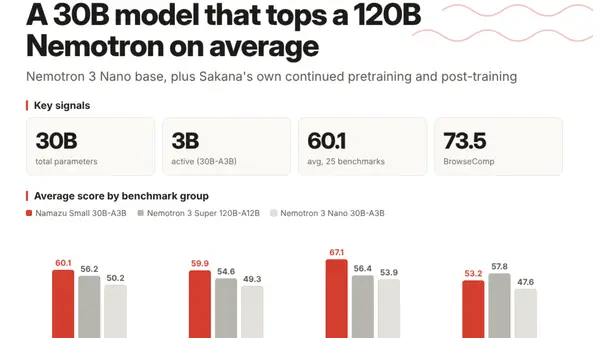
Sakana AI has released Namazu Small, a 30B reasoning model built on NVIDIA's Nemotron 3 Nano that uses only 3B parameters at a time. It scores 60.1 on a 25-benchmark average, ahead of the 120B Super, but lags on answering from memory.