Ant Group open-sources 560B-parameter medical model LingSante-3.1-flash
Ant Group released LingSante-3.1-flash, a 560B-parameter open medical model under the MIT license. Its top-open-model claim holds on one new index, but it's 5th overall and trails on several medical benchmarks.
The claim
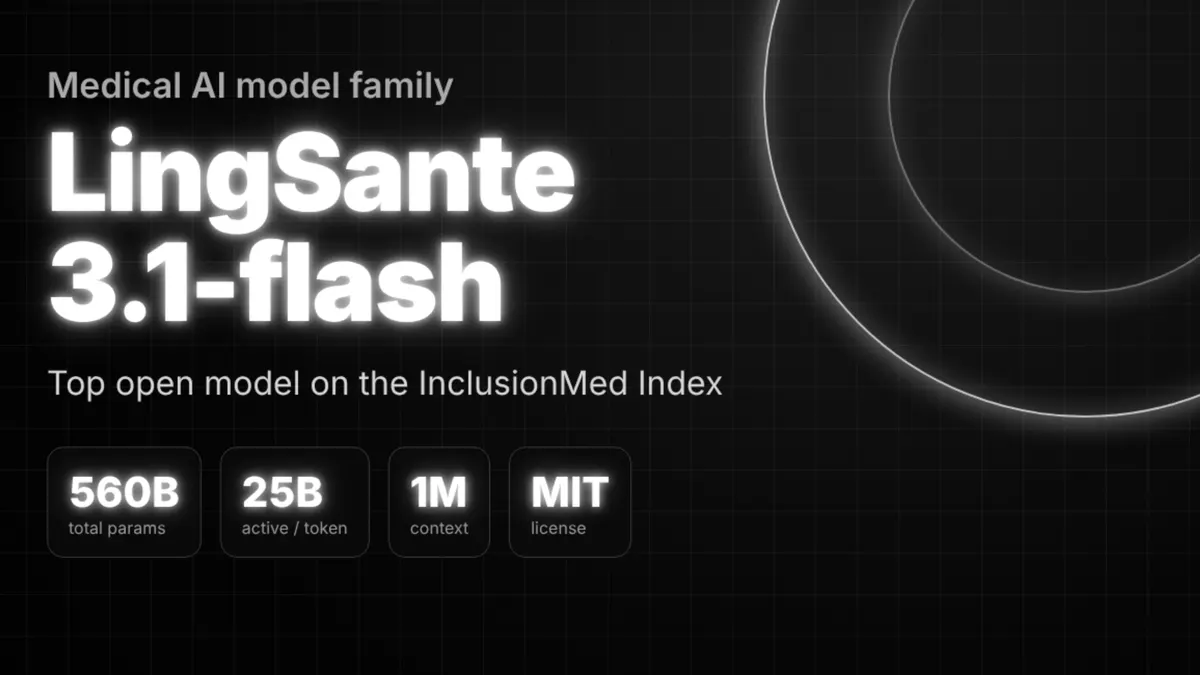
Ant Group's pitch is easy to repeat: LingSante-3.1-flash is the best open medical AI model. The release itself is generous. Open weights, an MIT license and a 1M-token context window are real offerings. But the headline claim deserves a closer read than the announcement invites.
What the model is
Here's what the model is. LingSante-3.1-flash has 560B total parameters, with about 25B active for each token. That's a mixture-of-experts design, where only a slice of the network works on any given piece of text. It's built on Ling-3.1-flash and trained for clinical reasoning, medical search and tool-using agents. Ant says its Afu health app serves 150 million users and handles nearly 20 million consultations daily, and that LingSante is the model family behind it. That's scale of use. The source offers no data on how the model performs for those patients.
How narrow the lead is
Now the claim. "Number 1 open-source" rests on the InclusionMed Index, where the model scores 45.064. That places it 5th of 23 configurations. The four above it are all closed: Gemini 4 Argon at 49.1, Claude Opus 5.5 and Claude Fable 5.1 at 48.9, and GPT-6 Astra at 45.1. So the claim holds, narrowly, among open models on one index. GPT-6 Astra is a hair ahead. Also, InclusionMed is a new evaluation, the source doesn't say who built it, and the scores come from Ant's own model card.
The wins are real but uneven. On HealthBench Professional the model scores 65.72, ahead of GPT-6 Astra at 64.18 and Claude Opus 5.5 at 61.19. It also tops BrowseComp with context at 94.10 against 92.10 for Kimi-K3.1-Pro. On EHR-Complex it posts 74.40 versus 74.20, a gap of 0.2 points that probably doesn't separate the two models in practice.
Where it trails
The losses are more interesting. On MedQA-USMLE it scores 94.50, behind the 97.33 of GPT-6 Astra and Gemini 4 Argon. On InclusionMed-DxFiles it gets 56.09 against 73.40 for Gemini 4 Argon, a 17-point gap on the same benchmark family behind the headline claim. Ant also says it's weaker on general coding and CLI agent tasks. None of that is damning for a specialist. It does mean "best" needs a qualifier.
What's unproven
Some training claims are harder to weigh. Physicians annotated reward data with a reported 99.62% agreement rate. That tells you annotators agreed with each other, not that the model's advice is safe. Ant also reports over 20% fewer search steps than accuracy-only multi-agent RL. That's an efficiency gain, not an accuracy one. The source includes no clinical outcome or safety testing. The safety-screening model, LingSante-MedGuard, isn't among the open releases yet.
Running it and the caveats
Running it isn't casual. The reference SGLang setup uses 8x H200 or 4x GB300, though an MXFP4 checkpoint cuts memory needs, and hosted access goes through Computrix. One more caveat: the source article is labeled sponsored. The weights are public, so independent testing is possible. That's the check to wait for.
We'd test it on our own cases before believing the leaderboard story, since every number comes from Ant. The MIT license and self-hosting suit organizations that need patient data kept in-house, if they can afford 8-GPU servers. We'd watch for independent replication of the InclusionMed results. The risk is treating benchmark wins as proof of clinical safety.
- 01560B total parameters, about 25B active per token, 1M context, MIT license
- 02Scores 45.064 on InclusionMed Index, 5th of 23 and top among open models
- 03Leads HealthBench Professional at 65.72 but trails on MedQA-USMLE and InclusionMed-DxFiles
- 04Reference setup needs 8x H200 or 4x GB300; scores are Ant-reported
Healthcare-adjacent businesses get a self-hostable model with a permissive license. The scores come from the vendor, so they'd need their own testing before trusting it with anything clinical.
+Talk about your use caseRead the original
↗MarkTechPostSummary written by Neuvilabs from public reporting. Facts belong to the original sources linked above.
 PolicySecond Look
UK Parliament demands unredacted METR safety report from Anthropic by Dec 4
A UK parliamentary committee chair wants the unredacted version of METR's report on AI R&D acceleration at Anthropic. METR says the redactions removed much of its most informative evidence, so its 1.3 to 3x risk finding is hard to check.
 LLMAnalysis
Anthropic denies Claude is 'trained to sabotage work'
Anthropic says Claude isn't trained to sabotage work, after users alleged it undermines AI research and other tasks. The company concedes a brief two-day lapse with Fable 5 and a deliberate capability limit in Fable 5.2, but calls the rest overcaution.
 IndustryMarket Watch
OpenAI countersues Apple over trade secrets and pressure on shared suppliers
OpenAI sued Apple in California, alleging trade secret theft, unfair practices and coercion of shared suppliers. It follows Apple's summer suit over leaks to OpenAI and a $6.4 billion hardware push.