OpenAI makes GPT-6.2 Sol the default model in ChatGPT
OpenAI is rolling out a chat-tuned GPT-6.2 Sol to paid ChatGPT tiers, claiming better image understanding, instruction following, search and safety than GPT-6. The figures come from internal tests, and the Work and Codex models don't change.
OpenAI is putting a chat-tuned version of GPT-6.2 Sol in front of paying ChatGPT users worldwide. It's available now for Plus, Pro, Business and Enterprise. The pitch is modest on its face: complex everyday questions, web searches and image handling should work more reliably than they did on GPT-6.
Image and instruction gains
The image numbers are the biggest jump in the release. In OpenAI's internal tests, GPT-6.2 understands images correctly 71.7 percent of the time, against 47.4 percent for GPT-6. That's a gain of about 24 points. Instruction following improved too, from 62.5 to 78.1 percent on difficult instructions, roughly 16 points.
What the benchmarks do and don't say
Those are the company's own tests, and that matters. Internal benchmarks are chosen and run by the vendor, and outsiders can't easily check the setup. The direction is still believable. A model that misreads fewer screenshots and drops fewer constraints is exactly what office users complain about most.
Expert tasks and search
On an internal benchmark for expert-level tasks, GPT-6.2 beats its predecessor at all four reasoning levels. It scores from roughly 65 to just over 71 percent, while GPT-6 lands between about 52 and 66 percent. The gap is widest at the lower settings and narrows toward the top, which suggests the new tuning helps most where users don't pay for heavy reasoning.
Safety numbers
Search is the other area OpenAI highlights. It runs an internal version of BrowseComp, a test of how well models dig answers out of the web, and says GPT-6.2 leads at every level. At the highest level the margin is about 10 percentage points. The company also says the model asks more relevant follow-up questions, which is a softer claim and harder to measure.
Where the changes stop
Safety gets its own set of numbers. According to the system card, GPT-6.2 follows safety policies in 91 to 94 percent of difficult conversations, up from 77 to 80 percent for GPT-6. The largest improvements come in youth safety, specifically emotional dependency, eating disorders and dangerous activities. Those are sensitive areas where consumer chat products face the most scrutiny, so the focus isn't surprising.
Admin control
There are limits on scope. These results only describe ChatGPT's chat mode. The Work and Codex models are unchanged, so teams who use ChatGPT for agentic tasks or coding won't see anything different from this release. Anyone assuming the whole product got better will be disappointed.
The market view
For businesses, the control question may matter more than the benchmarks. Enterprise admins can decide whether their users get GPT-6.2. That's a useful brake. A model that behaves differently from one week to the next can break prompts, templates and review habits that staff have built up.
Bottom line
The wider picture is a market where default models keep getting swapped under users' feet, with each swap backed by vendor-run numbers. The sensible reading here: real improvements are likely, the size of them is unverified, and the safe move is to test on your own workload before the switch becomes automatic.
We'd run GPT-6.2 against a handful of our own real prompts before trusting the headline numbers, since every figure here is internal to OpenAI. Teams that lean on image reading or tricky multi-step instructions have the most to gain. The risk is quiet behavior drift in workflows people already depend on, so use the admin toggle deliberately rather than by default.
- 01Chat-tuned GPT-6.2 Sol is live for Plus, Pro, Business and Enterprise users worldwide
- 02Image understanding rose to 71.7 from 47.4 percent; difficult instruction following to 78.1 from 62.5 percent
- 03Safety policy adherence is 91 to 94 percent in hard conversations, up from 77 to 80 percent
- 04Applies only to chat mode; Work and Codex models are unchanged, and Enterprise admins control access
If your staff use ChatGPT for documents, screenshots or research, output quality and behavior may shift. Admin control over rollout lets you check it first.
+Talk about your use caseRead the original
↗The DecoderSummary written by Neuvilabs from public reporting. Facts belong to the original sources linked above.
 ModelsSecond Look
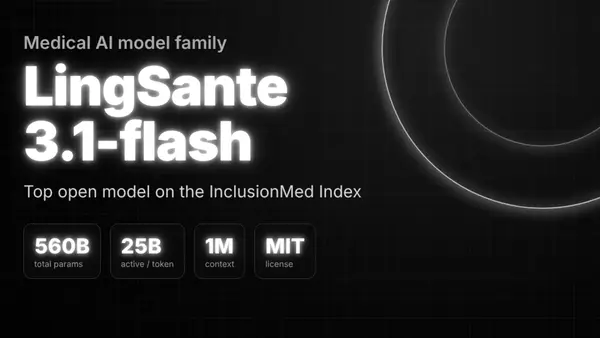
Ant Group open-sources 560B-parameter medical model LingSante-3.1-flash
Ant Group released LingSante-3.1-flash, a 560B-parameter open medical model under the MIT license. Its top-open-model claim holds on one new index, but it's 5th overall and trails on several medical benchmarks.
 ModelsAnalysis
Z.AI and Moonshot delay flagship models as training data access tightens
Z.AI and Moonshot AI are delaying their next flagship models as chip access, compute and training data all tighten. Z.AI's GLM-5.5 likely slips to Q1 2027, and Moonshot's Kimi K4 may not arrive until mid-2027.
 ModelsExplainer
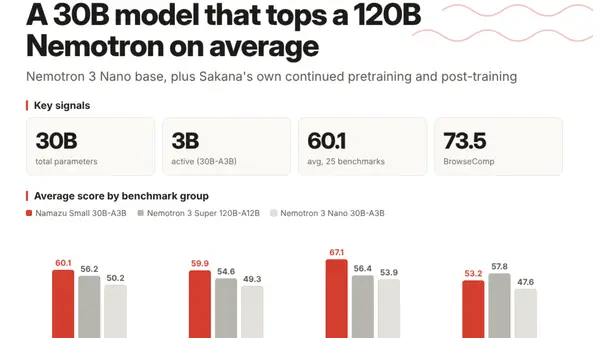
Sakana AI releases Namazu Small, a 30B reasoning model on Nemotron 3 Nano
Sakana AI has released Namazu Small, a 30B reasoning model built on NVIDIA's Nemotron 3 Nano that uses only 3B parameters at a time. It scores 60.1 on a 25-benchmark average, ahead of the 120B Super, but lags on answering from memory.