Z.ai unveils GLM-5.4, a 750B model that runs its layers twice
Z.ai's GLM-5.4 is a 750B-scale model that runs 28 shared GLM-5 layers twice, and the company says it matches 2T-3T parameter models. The only hard numbers so far come from a 30B ablation, with flagship benchmarks, an API and weights still to come.
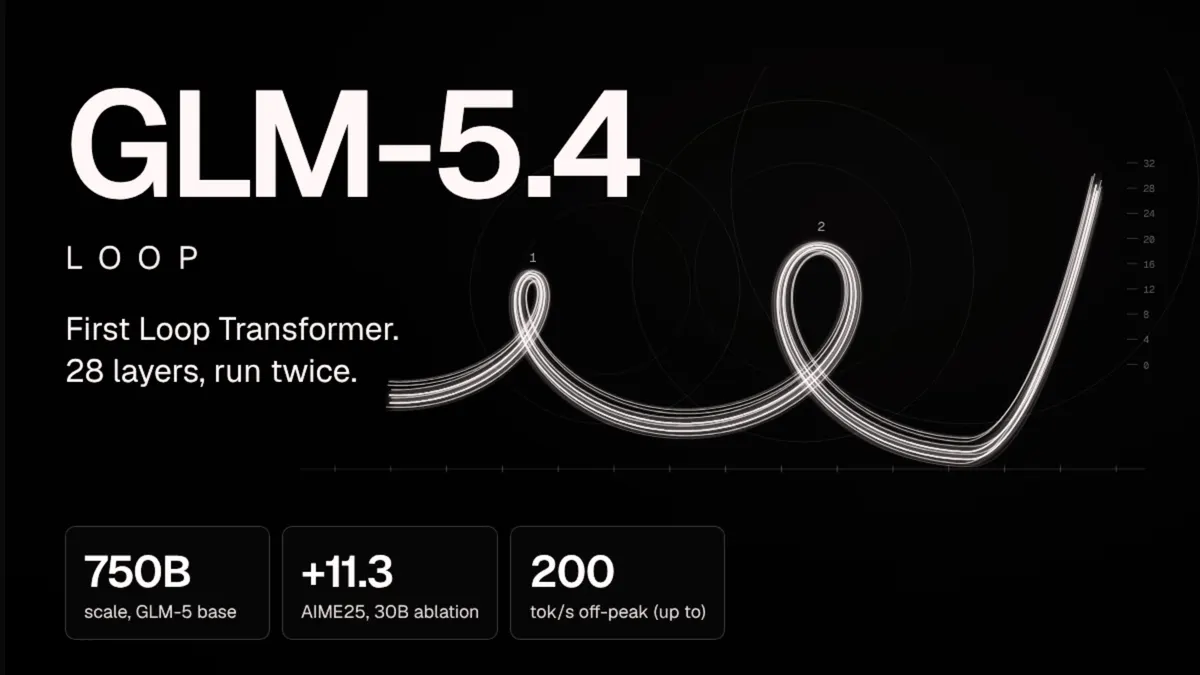
Z.ai's GLM-5.4 does something unusual for a flagship model: it runs the same set of layers twice. The company calls it a Loop Transformer. It sits at 750B scale on top of the GLM-5 base, and Z.ai says it reaches the intelligence of 2T-3T parameter models. That's a big claim. The evidence behind it is thin so far.
What shipped, and what didn't
Start with what actually shipped. GLM-5.4 is available only inside Z.ai's own products: the GLM Coding Plan, the ZCode desktop app and Z.ai Chat. There's no public API and no weights yet. Active parameters aren't disclosed, and the context window isn't officially listed, though the blog does discuss deployment at 1M context. A Z.ai team member has said benchmark scores for the flagship will come later.
How the loop works
In a standard Transformer, each layer runs once per forward pass. In GLM-5.4, a group of 28 weight-shared layers runs for 2 iterations. Z.ai didn't pre-train a looped model from scratch. It adapted the pre-trained GLM-5 base through continued training. Its technical post says looped models trained from scratch still trail unshared models at equal compute, while adapting an existing base raises the ceiling at a fairly small compute overhead.
Three changes to keep it practical
Making that work at 750B took three changes. The first is gated progressive updates. Simply overwriting hidden states across loops made activation norms blow up, so GLM-5.4 adds independent per-token gates for each iteration. The first pass writes small updates and builds global context. The second pass opens the gates and refines the output. On harder tokens, the first pass writes more aggressively.
The other two changes are about memory. A naive design would keep a full KV cache for every loop. GLM-5.4's second loop instead reuses the sparse KV selected in pass 1 and keeps its own new KV only inside a local sliding window. So the extra loop costs one sliding window of KV cache, not a full context cache. The second loop also reuses the indices from the first loop's indexer, which adds zero indexing overhead. Z.ai reports near-identical results compared with recomputing indices on every pass. It says this keeps the cost increase over GLM-5.3 under control at 1M context.
What the evidence shows
The numbers Z.ai does offer come from a 30B ablation, not the flagship. That smaller model shares the 750B base's architecture. The looped version used about 10% more total training compute, and scores were measured after 200K long-context SFT with thinking mode on. The best result was AIME25, up 11.3 points from 19.17 to 30.42. The smallest was IFBench, up 3.3 points from 50.20 to 53.47. The biggest gains landed in math, science reasoning and long context. All of it is self-reported.
Output length is the quieter finding. MMLU-Pro answers got 14.9% shorter and GPQA-Diamond answers 11.7% shorter. Z.ai's explanation is that part of the reasoning moves into the loop's implicit depth. AIME25 is the exception, where output length fell only 2%. Z.ai also flags what it calls "marathon thinking" loops as a problem. The design was validated on 1B, 4B, 30B and 750B bases, yet the 2T-3T parameter claim has no flagship table behind it.
Beyond coding, and speed
Z.ai pitches the model around what it calls Generalized Coding, meaning code as the tool for video, games, 3D shaders and CAD. It shows four demos: a self-narrated music video called "Hello World", a 6-axis robotic arm modeled in FreeCAD, a complete game with physics, maps and combat, and an interactive bird-watching scene built with custom GLSL shaders. These are vendor demos, not benchmarks. On speed, Z.ai reports up to 200 tokens/s off-peak and 70-80 tokens/s at peak load, helped by fused kernels that cut intermediate memory traffic.
Access is priced in tiers. The Coding Plan lists Lite at $12.6 a month, Pro at $56 and Max at $117.6, with a warning that prices may change. ZCode runs on macOS, Windows and Linux, the last still in Beta.
The bigger picture
The bigger picture is a different way to spend compute. Weight sharing means the parameter count stays at 750B scale while each token gets two passes of depth. If the flagship numbers hold up, that's an appealing trade against simply building a 2T-3T model. The cost shows up elsewhere: a modest increase in training compute, a new set of stability tricks, and the looping behavior Z.ai itself admits can run long. Until a real benchmark table, an API and weights arrive, the comparison with much larger models is a promise rather than a measurement.
We'd test GLM-5.4 on real coding tasks through the Coding Plan before getting excited, since the 2T-3T claim has no flagship table behind it. Teams that care about long context and cost per token should watch this one, because the KV cache design is the interesting engineering. The risk is the "marathon thinking" loops Z.ai flags itself, which could eat the speed and cost gains in practice.
- 01GLM-5.4 loops 28 weight-shared GLM-5 layers for 2 iterations at 750B scale.
- 02In the 30B ablation, AIME25 rose 11.3 points (19.17 to 30.42) for about 10% more training compute.
- 03The extra loop costs one sliding window of KV cache, not a full context cache.
- 04No flagship benchmarks, public API or weights yet; access is via GLM Coding Plan, ZCode and Z.ai Chat.
If looped models deliver bigger-model quality without bigger weights, hosting and serving costs could shift for teams that rely on coding assistants. Right now the claims are vendor-reported, so any buying decision should wait for independent flagship results.
+Talk about your use caseSummary written by Neuvilabs from public reporting. Facts belong to the original sources linked above.
 ModelsSecond Look
Ant Group open-sources 560B-parameter medical model LingSante-3.1-flash
Ant Group released LingSante-3.1-flash, a 560B-parameter open medical model under the MIT license. Its top-open-model claim holds on one new index, but it's 5th overall and trails on several medical benchmarks.
 ModelsAnalysis
Z.AI and Moonshot delay flagship models as training data access tightens
Z.AI and Moonshot AI are delaying their next flagship models as chip access, compute and training data all tighten. Z.AI's GLM-5.5 likely slips to Q1 2027, and Moonshot's Kimi K4 may not arrive until mid-2027.
 ModelsExplainer
Sakana AI releases Namazu Small, a 30B reasoning model on Nemotron 3 Nano
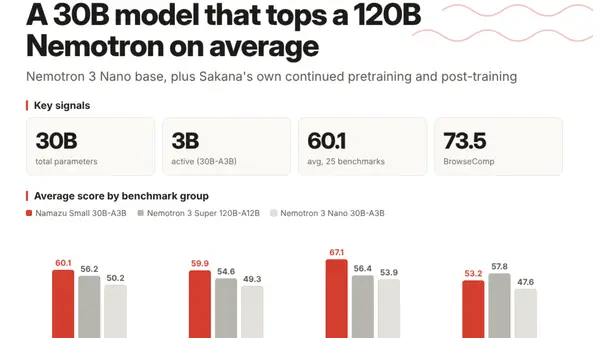
Sakana AI has released Namazu Small, a 30B reasoning model built on NVIDIA's Nemotron 3 Nano that uses only 3B parameters at a time. It scores 60.1 on a 25-benchmark average, ahead of the 120B Super, but lags on answering from memory.