OpenAI makes GPT-6.2 Sol the default model in ChatGPT
OpenAI made a chat-tuned GPT-6.2 Sol the ChatGPT default and reports gains in images, instructions, search and safety. Nearly all the evidence comes from OpenAI's own tests.
What OpenAI says
OpenAI is rolling out a chat-tuned version of GPT-6.2 Sol worldwide, and Plus, Pro, Business and Enterprise users can get it now. The company's pitch is that the model handles complex requests and web searches better than GPT-6 and asks more relevant follow-up questions. That's a sensible list of improvements for a default model. The harder question is how much of it anyone outside OpenAI can check.
The size of the jumps
Start with the headline numbers. In internal tests, GPT-6.2 understands images better, scoring 71.7 percent against 47.4 for GPT-6. It follows difficult instructions more often, 78.1 percent against 62.5. Those are gaps of roughly 24 and 16 points. Jumps that big deserve a look at what the tests actually contain, and the announcement doesn't say.
Benchmarks OpenAI wrote itself
The expert-level benchmark follows the same pattern. OpenAI says GPT-6.2 beats GPT-6 at all four reasoning levels, scoring roughly 65 to just over 71 percent while GPT-6 lands between about 52 and 66. The ranges hint that the lead may be smaller at some levels than at others, though the source gives no per-level breakdown. The web-search claim rests on an internal version of BrowseComp, where GPT-6.2 leads at every level and finishes about 10 points ahead at the highest one.
Notice the word internal, used again and again. These are OpenAI's own tests, run by OpenAI, with no outside replication mentioned. That's normal for a launch. It's also a reason to hold the figures loosely until independent testers publish their own.
Safety figures
The system card says GPT-6.2 follows safety policies in 91 to 94 percent of difficult conversations, up from 77 to 80 percent for GPT-6. The biggest gains are in youth safety, specifically emotional dependency, eating disorders and dangerous activities. Those are areas where progress counts for something. Still, a policy-following rate depends on which conversations get labeled difficult and who does the grading. The source doesn't cover either. Run the math the other way, too: by these figures, 6 to 9 percent of difficult conversations still fall short.
Scope and controls
Scope matters here. These numbers apply only to ChatGPT's chat mode. The Work and Codex models stay the same, so anyone using ChatGPT mainly for coding or agent-style tasks shouldn't expect these gains to carry over. Enterprise admins can decide whether their users get GPT-6.2 at all, which gives organizations a useful brake.
What's still missing
What's missing is a fair list. There are no third-party results, no description of how the image and instruction tests were built, and no word on cost or speed. Nothing shows how often the better follow-up questions actually help. For a business, the sensible move is to run GPT-6.2 on your own material: your documents, your support questions, your images. Pilot it with a small group first if admin controls allow. If the jump from 47.4 to 71.7 on images is real, you'll see it quickly in daily work, and that's a test OpenAI can't run for you.
The reported gains are large enough to be worth testing, and the admin control for Enterprise is a good sign. We wouldn't take the internal benchmark numbers at face value, though. Teams should build a small test set from real work and compare GPT-6 and GPT-6.2 side by side, especially on image and instruction-heavy tasks. Watch for independent evaluations, and remember the Work and Codex models didn't change.
- 01Chat-tuned GPT-6.2 Sol is available worldwide for Plus, Pro, Business and Enterprise users
- 02Internal tests: images 71.7 vs. 47.4 percent, difficult instructions 78.1 vs. 62.5 percent
- 03System card: 91 to 94 percent safety-policy adherence in difficult conversations, up from 77 to 80
- 04Applies only to ChatGPT's chat mode; Work and Codex models unchanged
If your team uses ChatGPT's chat mode, behavior may change when GPT-6.2 reaches your users. Check it against your own tasks before assuming the published gains apply.
+Talk about your use caseRead the original
↗The DecoderSummary written by Neuvilabs from public reporting. Facts belong to the original sources linked above.
 ModelsSecond Look
Ant Group open-sources 560B-parameter medical model LingSante-3.1-flash
Ant Group released LingSante-3.1-flash, a 560B-parameter open medical model under the MIT license. Its top-open-model claim holds on one new index, but it's 5th overall and trails on several medical benchmarks.
 ModelsAnalysis
Z.AI and Moonshot delay flagship models as training data access tightens
Z.AI and Moonshot AI are delaying their next flagship models as chip access, compute and training data all tighten. Z.AI's GLM-5.5 likely slips to Q1 2027, and Moonshot's Kimi K4 may not arrive until mid-2027.
 ModelsExplainer
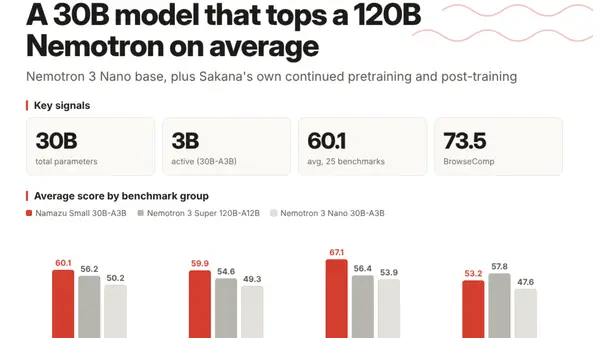
Sakana AI releases Namazu Small, a 30B reasoning model on Nemotron 3 Nano
Sakana AI has released Namazu Small, a 30B reasoning model built on NVIDIA's Nemotron 3 Nano that uses only 3B parameters at a time. It scores 60.1 on a 25-benchmark average, ahead of the 120B Super, but lags on answering from memory.