Q.ANT uses light to run AI calculations with less energy
Q.ANT, a German startup, builds photonic chips that compute with light to cut the energy AI uses. Its CEO says they're meant to sit beside GPUs, not replace them, though real-hardware gains aren't proven yet.
Why light
AI is getting more expensive to run, and a big slice of that bill is electricity. Labs and cloud providers want to build data centers where power is cheap and renewable, Scandinavia being the usual example. But shipping delays, scarce components and a growing wave of local protests keep slowing those plans down.
How it works
German startup Q.ANT is trying a different angle. It builds photonic processors, chips that do their work with light instead of electricity. WIRED recently interviewed its founder and CEO, Michael Förtsch, and the conversation is a useful way to understand what these chips are and what they aren't.
The circle trick
Start with the basics. A regular GPU (graphics processing unit, the chip that powers most AI today) moves and processes data by pushing electrons around. A photonic processor uses waves of light. Light doesn't create heat as it travels, and it can carry more data at the same time. In theory, that means less energy used and far less cooling. Cooling is one of the biggest costs for any data center.
Where it fits
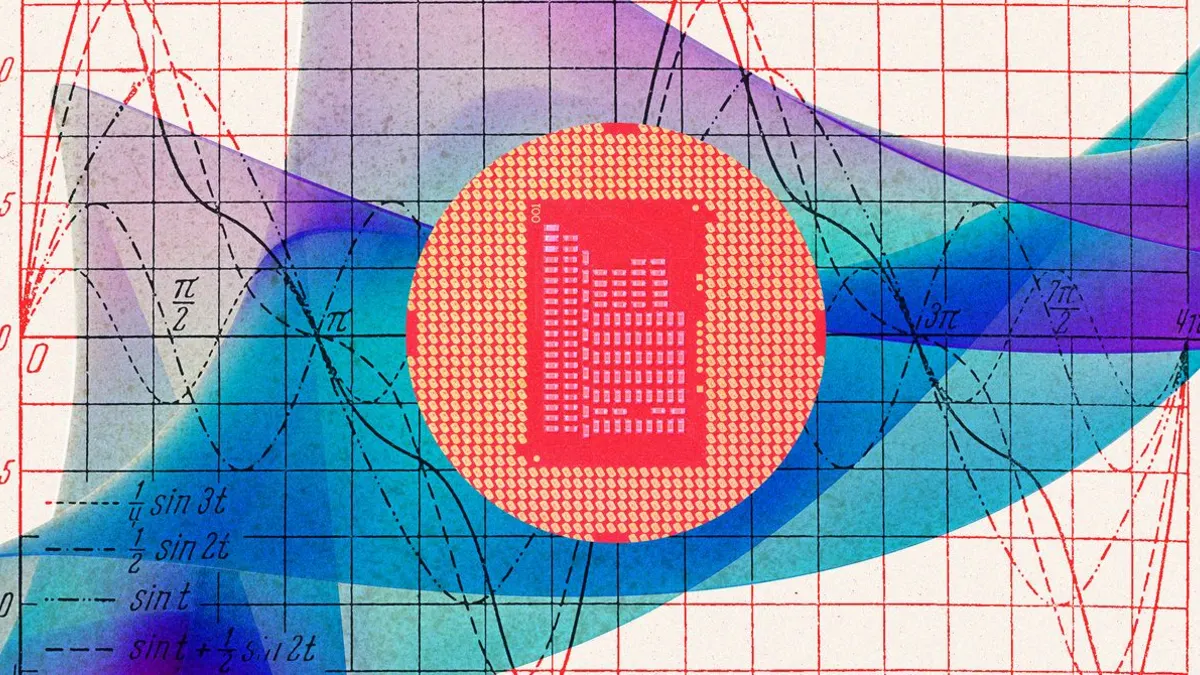
Here's the analogy Förtsch uses. Light is a wave, and a wave follows a sine function, a rule that draws a smooth, repeating curve. Say you want to describe a circle using only straight lines. You'd need endless points and segments to get it right. With a sine wave, he says, two points will do. Think of drawing a circle with a compass instead of a ruler. The tool already matches the shape.
Aimed at images and robots
That's why Q.ANT says its chips are good at nonlinear math, the curvy, complicated kind. GPUs are the opposite. They're excellent at linear math, which is huge piles of additions and multiplications. So the plan isn't to replace GPUs. Förtsch calls the Nvidia H200 'a masterpiece of technology' and says it's hard to beat on its home turf. The photonic chip works as a coprocessor, a helper that takes the heavy math while the GPU handles the rest. 'Linear math? Please route it to the GPU,' he says. 'Non-linear and complex stuff? Please route it to us.'
What's still unproven
The company expects to be strongest with images and video, meaning recognition, segmentation and generation, plus robotics and what's called physical AI. Förtsch says complicated math runs in a single step on Q.ANT's hardware, where regular chips need thousands. Fewer steps means fewer trips to memory, and memory access is a major cost driver today.
The chicken and the egg
Now the caveats, and there are several. In simulation, Q.ANT sees roughly four to five times less energy use. On real hardware, Förtsch admits, it hasn't shown that yet. Code written in C++ or Python can already run on the machines, but software tuned for GPUs won't automatically get faster. Developers have to adapt it.
Pilots and supply
That sets up a chicken-and-egg problem. Cloud providers won't buy chips nobody builds for, and developers won't build for chips nobody can rent. Q.ANT's answer is pilots. It has rolled its chips out to facilities run by cloud company IONOS, and says more than 30 engineering teams are now building AI models for photonic computing. Förtsch puts it this way: 'We are building a new chicken, so you can start producing eggs.'
Supply is another hurdle. Förtsch says Q.ANT could handle an order of 100,000 chips but isn't sure about its suppliers, since the supply chain isn't yet as mature as the semiconductor world's. One thing helps: the chips need only 90 nanometer technology from the 2000s, which many foundries already use cheaply. And whether any of this reaches real data centers at scale is still an open question.
We find the coprocessor idea more believable than a GPU replacement pitch. The four-to-five-times energy figure comes from simulation only, so we'd treat it as a claim until real hardware shows it. Teams doing image, video or robotics work should keep an eye on the IONOS pilot. Everyone else can wait for independent benchmarks.
- 01Q.ANT's photonic processors use light instead of electrons and are meant to work alongside GPUs.
- 02Simulations show about 4-5x lower energy use, but real hardware hasn't demonstrated it yet.
- 03Chips are in a pilot at IONOS data centers, with 30+ engineering teams building models for them.
- 04Software tuned for GPUs needs adapting before it benefits from photonic hardware.
Energy is a growing part of what AI costs to run, so hardware that cuts power and cooling could change future pricing. For now it's an early technology worth watching, not something to plan a budget around.
+Talk about your use caseRead the original
↗WiredSummary written by Neuvilabs from public reporting. Facts belong to the original sources linked above.
 ResearchExplainer
UK AI Security Institute questions simulated tests of AI agent monitors
A UK AI Security Institute study found that a GPT-5.4 monitor missed 0.2 to 0.5 percent of simulated attacks under standard tests but nearly 23 percent under optimized ones. The researchers say today's sabotage tests may give a false sense of security.
 ResearchExplainer
Three studies back LeCun's JEPA world models as an alternative to LLMs
Three studies from Meta and AMI Labs support Yann LeCun's push for JEPA world models over language-model-only AI. The work targets machines that understand cause and effect and plan ahead, with physics still setting limits.
 ResearchExplainer
Terence Tao envisions 'Big Math' with AI, criticizes opaque tech-firm proofs
Terence Tao says AI will push mathematics toward larger collaborations he calls "Big Math." He also calls tech firms' unexplained AI proofs "toxic waste."