OpenAI tests Private Inference so companies can run queries it cannot see
OpenAI is piloting Private Inference with its first enterprise customers, promising that it can't see the data in queries run on its top models. The setup relies on isolated, independently verifiable hardware and a separate abuse-scanning system.
The pitch
OpenAI says it's piloting a feature called Private Inference with its first enterprise customers. The pitch is simple to state and hard to do: you run queries on its most powerful models, and OpenAI can't see the data. Sam Altman's line was that better privacy makes AI useful for a much wider range of work. Builders who've had a legal team kill a promising prototype will recognize the problem he's describing.
What's actually claimed
Here's what the source tells us about the mechanism. Queries are processed on specially isolated hardware, and OpenAI says its security can be independently verified. That second part matters more than the first. A promise not to look is a policy. Hardware you can have checked by someone else is at least an engineering claim. The source doesn't say who does the verifying or how, so treat that as the first thing to ask in any pilot conversation.
Abuse scanning, minus the reading
Then there's the abuse-scanning problem. Providers normally want to read traffic to catch misuse, and that's exactly what a private setup removes. Altman pointed to a companion system called Private Safety Processing. It lets OpenAI scan for abuse without storing customer data. Flagged content gets encrypted and stored in the customer's own cloud, and only a secured review system can read it. So the data that trips a flag lands in your storage, not theirs. Handy for your security review. Also one more piece of infrastructure to understand before you sign anything.
Getting in
What would integration look like? The source doesn't describe the API, pricing or availability, so I won't guess. What we do know: it targets business customers first, and OpenAI is still scaling up the compute capacity needed to expand it. Expect a waitlist, not a toggle in the dashboard. If you're building anything in healthcare, legal or finance, it's worth getting your name in early and listing which workloads are currently blocked on data-handling grounds.
Not the same as no-training
A small point of context. Business customers' data already isn't used for training at OpenAI. Consumer ChatGPT conversations are, by default, unless users opt out. So Private Inference isn't about training. It goes a step further: the provider's own staff and systems can't read the queries at all. For a compliance questionnaire, those are two different answers, and you'll want to keep them apart in your documentation.
Google's in the room too
Shekar, the OpenAI employee leading the effort, called it a first step toward "private intelligence for everyone." Note the "first step." Google is working on a similar approach with Private AI Compute, so this isn't a one-vendor idea. Competition here is good news for anyone who has to pick a vendor later.
What I'd do Monday
Practically, my advice is dull. Pick one sensitive workflow, write down what auditors would need to see, and compare that list to whatever verification evidence OpenAI can provide. Test latency and cost on isolated hardware, since the source says nothing about either. And don't redesign your architecture around a pilot.
We'd want to try it on one sensitive workflow once access opens up. Regulated-industry teams should care most. The thing to watch is what independent verification means in practice, plus pricing and latency, which the announcement doesn't cover. Until those are clear, it's a pilot, not a plan.
- 01Private Inference lets companies query OpenAI's top models without OpenAI accessing the data
- 02Runs on isolated hardware whose security can be independently verified, per OpenAI
- 03Private Safety Processing scans for abuse; flagged content is encrypted and kept in the customer's own cloud
- 04Targets business customers first while OpenAI scales up compute; Google has Private AI Compute
If your data-handling rules have blocked AI projects, a provider that technically can't read your queries could reopen them. You'll still need to see the verification evidence before relying on it.
+Talk about your use caseRead the original
↗The DecoderSummary written by Neuvilabs from public reporting. Facts belong to the original sources linked above.
 ToolsBuilder's Notes
OpenAI is building 'Athena' to make data agents more accurate
OpenAI is reportedly building a data platform called "Athena" that works like a semantic layer, giving its agents consistent business metric definitions. It's early, with no timeline or pricing announced.
 ToolsBuilder's Notes
OpenAI is building "Athena" to make data agents more accurate
OpenAI is building a data platform called Athena that works like a semantic layer, giving AI agents consistent definitions for business metrics. It's early, with no timeline or pricing announced.
 ToolsThe Brief
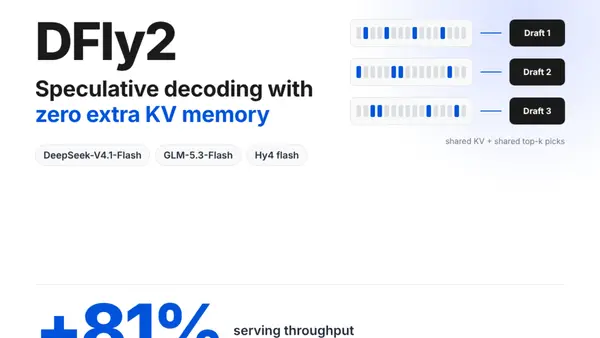
Tencent open-sources DFly2 to speed up sparse-attention LLM serving
Tencent has open-sourced DFly2, a speculative decoding drafter that reuses a sparse target model's KV cache and indexer picks. Tencent reports up to 81% more throughput on DeepSeek-V4.1-Flash at 64K context.