Tencent open-sources DFly2 to speed up sparse-attention LLM serving
Tencent has open-sourced DFly2, a speculative decoding drafter that reuses a sparse target model's KV cache and indexer picks. Tencent reports up to 81% more throughput on DeepSeek-V4.1-Flash at 64K context.
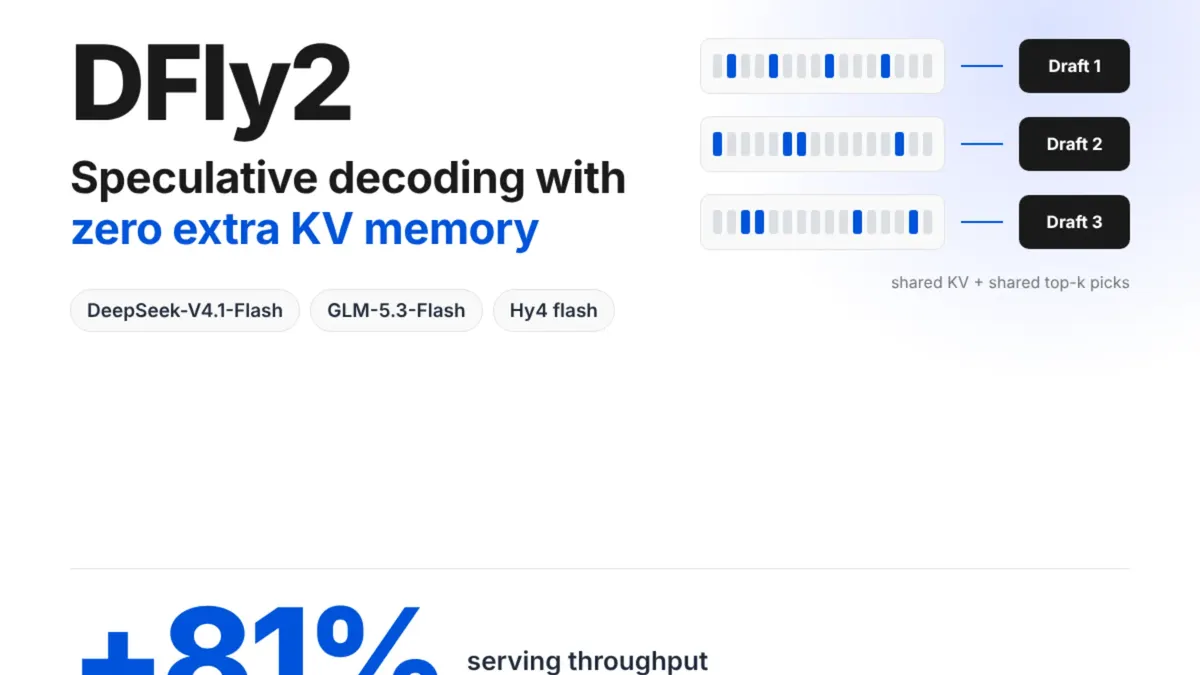
Tencent has open-sourced DFly2, a speculative decoding drafter built for natively sparse large language models. The Hunyuan AI Infra team developed it. It targets DeepSeek-V4.1-Flash, GLM-5.3-Flash and Tencent's own Hy4 flash. The drafter keeps no KV cache of its own. In long-context and agentic serving, draft memory competes with concurrency for the same space.
Speculative decoding uses a small drafter to propose tokens. The target model verifies them in one pass, so output stays lossless. With long context, a normal drafter attends over the whole prefix and stores its own KV cache. DFly2 pairs each draft layer with one sparse attention layer in the target. The draft layer reads that target layer's latent KV cache and attends only to positions the target's indexer already selected. Each draft layer starts from the paired target layer's weights. The target's last-layer hidden state is gated into the draft block. The drafter rereads the shared context slot by slot within a block.
On DeepSeek-V4.1-Flash, a selection made one step early covers close to 90% of what later block tokens select. A same-size sliding window recovers less than 20%. Per the AngelSpec GitHub page, each draft token attends to at most about 2K keys, so drafting cost stays roughly flat at any context length. DFly2 also skips prefill. The prefill-to-decode transfer adds one last-layer hidden state. At 32K, removing the drafter's cache lets the same memory pool hold 1.73x as many requests.
All benchmark numbers are self-reported by Tencent. The baselines are DFlash and DSpark, retrained on the same recipe. The acceptance margin over the stronger baseline is 3.9% to 10.5% on general workloads and 10.0% to 31.5% on long-context and agentic workloads up to 128K. End-to-end speedup at concurrency 1 is 2.97x on DeepSeek-V4.1-Flash, 2.36x on GLM-5.3-Flash and 3.19x on Hy4 flash. Against DSpark at matched per-user decode speed, throughput on DeepSeek-V4.1-Flash rises 28% on short text, 62% on CodeSpan 64K and 81% on SWE 64K. The smallest gain is 3.9% over DSpark on Hy4 flash general tasks at temperature 0.
DFly2 ships inside tencent/Hy4-flash, a mixture-of-experts model with 220B total parameters, roughly 12B active, and 1M context. The drafter has 0.85B parameters and 5 layers. vLLM serves it with the dfly speculative method, which is on by default in the recipe. SGLang uses the DFLY algorithm. Serving tests used NVIDIA H20 GPUs with vLLM at TP8 per instance. Teams that want a drafter for their own sparse model can train one with AngelSpec. Its quick start expects one node with 8 GPUs: four for inference and four for training.
This is mostly relevant to teams that self-host sparse models and watch GPU memory closely. Everyone else will see it only as a faster Hy4 flash. The figures come from Tencent, so we'd rerun them on our own workloads before planning around them. The thin 3.9% gain on general tasks shows the benefit depends heavily on how long your prompts run.
- 01DFly2 drafter shares the target's sparse KV cache and indexer picks, so it adds no draft KV memory.
- 02Up to 81% more throughput on DeepSeek-V4.1-Flash (SWE 64K) at matched per-user speed, per Tencent.
- 03Smallest gain: 3.9% over DSpark on Hy4 flash general tasks at temperature 0.
- 04Ships in Hy4 flash on vLLM and SGLang; AngelSpec trains drafters for other sparse models.
Draft memory eats into how many users a long-context or agent deployment can serve at once. A drafter with no cache of its own frees that memory, if the self-reported numbers hold up.
+Talk about your use caseRead the original
↗MarkTechPostSummary written by Neuvilabs from public reporting. Facts belong to the original sources linked above.
 ToolsBuilder's Notes
OpenAI is building 'Athena' to make data agents more accurate
OpenAI is reportedly building a data platform called "Athena" that works like a semantic layer, giving its agents consistent business metric definitions. It's early, with no timeline or pricing announced.
 PolicySecond Look
Nvidia pauses server shipments to Southeast Asia as US tightens chip curbs
Nvidia has reportedly told Dell, Super Micro and other partners to pause server shipments to Malaysia, Singapore, Thailand and Indonesia while it checks export compliance. The reasons are plausible, but the report offers no evidence of violations and no end date.
 IndustryMarket Watch
OpenAI countersues Apple over trade secrets and pressure on suppliers
OpenAI has countersued Apple in California, alleging trade secret theft and coercion of shared suppliers. It follows Apple's own summer lawsuit over leaks and comes as OpenAI prepares devices to compete with the iPhone.