OpenAI tests Private Inference so firms can use top models without OpenAI seeing data
OpenAI is piloting Private Inference with its first enterprise customers. It lets companies run queries on top models on isolated, independently verifiable hardware, with OpenAI unable to access the data.
The pitch
Here's the pitch in one line: you send OpenAI's strongest models your sensitive queries, and OpenAI can't read them. Sam Altman says the company has started piloting Private Inference with its first enterprise customers. It was announced earlier, and now real accounts are touching it. Altman's argument is that better privacy makes AI useful for a much wider range of work. Anyone who has watched a legal or finance team block a pilot over data handling will recognize that.
What's actually being claimed
The engineering claim is specific. Queries get processed on specially isolated hardware, and OpenAI says the security of that hardware can be independently verified. That second part matters more than the first. Plenty of vendors say 'trust us.' Verification by someone else is a different kind of promise, because your security team can ask for evidence instead of a policy PDF. We don't have the technical details from the source, so we can't say what the verification looks like in practice.
Who gets it, and when
Shekar, the OpenAI employee leading the effort, called this a first step toward 'private intelligence for everyone.' Note the word 'first.' Right now the offer is aimed at business customers, and OpenAI is still scaling up the compute needed to expand it. If you're hoping to switch it on for your team tomorrow, don't plan around that. Expect a waitlist-shaped rollout, with early enterprise customers going first.
Training isn't the same as visibility
Business customers are the target for a reason. OpenAI already doesn't use their data for training. Consumer ChatGPT works the other way: conversations are used for training by default unless users opt out. So the gap Private Inference closes is a different one. 'Not trained on' is a promise about what happens to data afterward. Private Inference is about whether OpenAI can see the data at all while the model is running. Those are two separate worries, and procurement forms usually ask about both.
The abuse-scanning piece
Altman also pointed to Private Safety Processing, and this is the piece builders should read twice. Abuse scanning normally means someone has to look at content. Here, OpenAI says it can scan for abuse without storing customer data. When something gets flagged, the content is encrypted and stored in the customer's own cloud, and only a secured review system can read it. In plain terms, the evidence stays on your side of the fence. That's a neat answer to the 'but you need to catch misuse' objection.
Questions to bring to your rep
If you're planning an integration, a few questions are worth putting on your list now. Does the isolated-hardware path change latency or model availability? Which models does it cover? How does the flagged-content storage hook into your own cloud account, and who on your team owns that bucket? The source doesn't answer any of these, and the full article sits behind a paywall. Treat them as things to ask your OpenAI rep, not as things to assume.
Google's in the same lane
One more data point: Google is pursuing a similar approach with Private AI Compute. When two of the biggest providers head the same direction, it usually means buyers are asking for it loudly. For teams comparing vendors, that's useful leverage in a negotiation, though you should compare what each one lets you verify rather than the names of the programs. We'd keep a short list of regulated workloads parked until this opens up.
We'd want to try this on the workloads that are currently parked because of data sensitivity. Regulated teams in finance, health and legal should watch it most closely. The risk is that 'independently verifiable' stays a marketing line until someone shows what the verification involves, so ask for specifics before you commit. Capacity is still being scaled, so don't build a roadmap around it yet.
- 01OpenAI is piloting Private Inference with its first enterprise customers.
- 02Queries run on isolated hardware whose security can be independently verified, per OpenAI.
- 03Private Safety Processing scans for abuse without storing data; flagged content is encrypted in the customer's own cloud.
- 04Google is pursuing a similar approach with Private AI Compute.
If your legal or security team has blocked AI projects over data exposure, a verifiable no-access setup could reopen those conversations. Two big providers heading this way also gives buyers room to ask harder questions.
+Talk about your use caseRead the original
↗The DecoderSummary written by Neuvilabs from public reporting. Facts belong to the original sources linked above.
 ToolsBuilder's Notes
OpenAI is building 'Athena' to make data agents more accurate
OpenAI is reportedly building a data platform called "Athena" that works like a semantic layer, giving its agents consistent business metric definitions. It's early, with no timeline or pricing announced.
 ToolsBuilder's Notes
OpenAI is building "Athena" to make data agents more accurate
OpenAI is building a data platform called Athena that works like a semantic layer, giving AI agents consistent definitions for business metrics. It's early, with no timeline or pricing announced.
 ToolsThe Brief
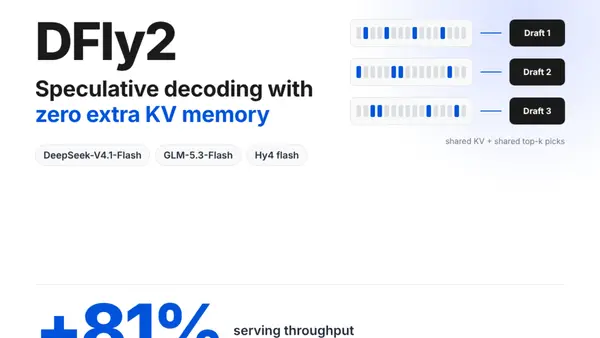
Tencent open-sources DFly2 to speed up sparse-attention LLM serving
Tencent has open-sourced DFly2, a speculative decoding drafter that reuses a sparse target model's KV cache and indexer picks. Tencent reports up to 81% more throughput on DeepSeek-V4.1-Flash at 64K context.