Anthropic launches Claude Ship so AI agents can review, fix and approve pull requests
Anthropic launched Claude Ship, a beta suite of agents that review, fix and approve routine pull requests. The notable piece is an agent that can approve changes automatically under a policy your team writes.

Code generation got fast. Everything after it didn't. Anthropic's answer is Claude Ship, announced Monday, a bundle of agents that review, fix and approve routine pull requests. It's in beta, and it's aimed at the queue that builds up once agents are writing most of your code.
What's in the box
Here's the lineup. Code Review is already generally available. Two new agents join it in beta: PR Steward and Claude Approvals. Code Review isn't new, and AI review features existed before this. The approval piece is the part that makes people sit up.
PR Steward
PR Steward handles the chores. Failing CI checks, merge conflicts, and feedback left by Code Review all land on it. After every push it comments on what it changed and how to roll that change back. That rollback note is a small detail I like. If a bot is pushing to your branch, you want an undo instruction attached to each push, not buried in a log.
Claude Approvals
Claude Approvals is the controversial one. It applies an approval policy your team writes as a file in the repository, in natural language. The policy can pull in signals such as Code Review findings or the company's own classifiers. So the rules live next to the code, get reviewed like code, and presumably get argued about in PR comments like everything else.
Rolling it out carefully
Anthropic's own advice is to be careful. Run approvals in observe-only mode first. Start with one repository. Set monthly spending limits. That's sensible, and I'd follow it to the letter. Observe-only mode means you can compare what the agent would have approved against what your humans actually approved, before it merges anything on its own.
Who stays in charge
You also keep some control. Teams choose where Claude Ship runs, which review setting to use (Quick, Standard or Deep), and which changes get escalated to a human. The escalation rules are where the real work is. A policy that says 'approve routine changes' is easy to write and hard to define.
The pitch comes from a company blog post: most teams want a person to approve every change, but on the Claude Code team, Claude writes most of the code, and they wanted everything after the PR to move at the same speed. Fair enough. It's also a company describing its own workflow as the template.
Where it runs
Availability is narrow for now. Claude Ship is rolling out to Claude Team and Enterprise plans, for repositories on GitHub only. If you're on another host, you're waiting.
We'd try it, but only in observe-only mode on a single low-risk repository with a spending cap. Teams already producing lots of agent-written code should care most. The risk is a vague natural-language policy that approves things a human would have flagged, so write the escalation rules first and audit the agent's decisions regularly.
- 01Claude Ship combines Code Review (generally available) with PR Steward and Claude Approvals (both beta)
- 02PR Steward fixes failing CI, merge conflicts and review feedback, and comments on what changed and how to roll back
- 03Claude Approvals follows a natural-language policy file stored in the repository
- 04Available on Claude Team and Enterprise plans for GitHub repositories
If AI agents write much of your code, review and approval become the bottleneck, and this targets exactly that. It also moves approval authority toward an AI, so your governance rules need to be clear before you switch it on.
+Talk about your use caseSummary written by Neuvilabs from public reporting. Facts belong to the original sources linked above.
 ToolsBuilder's Notes
OpenAI is building 'Athena' to make data agents more accurate
OpenAI is reportedly building a data platform called "Athena" that works like a semantic layer, giving its agents consistent business metric definitions. It's early, with no timeline or pricing announced.
 ToolsBuilder's Notes
OpenAI is building "Athena" to make data agents more accurate
OpenAI is building a data platform called Athena that works like a semantic layer, giving AI agents consistent definitions for business metrics. It's early, with no timeline or pricing announced.
 ToolsThe Brief
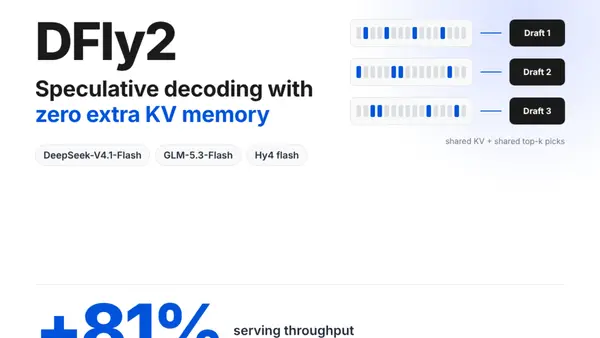
Tencent open-sources DFly2 to speed up sparse-attention LLM serving
Tencent has open-sourced DFly2, a speculative decoding drafter that reuses a sparse target model's KV cache and indexer picks. Tencent reports up to 81% more throughput on DeepSeek-V4.1-Flash at 64K context.