OpenAI and Cisco introduce Shirudo, an open-source Linux runtime for safer patching
OpenAI and Cisco released Shirudo, an open-source runtime that uses eBPF shields to protect Linux services while patches are prepared. In a controlled test, a Codex-generated shield blocked a Java4Shell exploit on a running Elasticsearch service without a restart.
Patching takes time. Testing and rolling out a fix can run days or weeks, and during that gap the vulnerable service sits there. OpenAI and Cisco have released Shirudo, an open-source runtime meant to cover that window on Linux systems.
The shield idea
The hard part is that an exploit and a legitimate request can rely on the same Linux operation. Block it outright and you may take the service down with the attack. Shirudo (Japanese for "shield") tries to avoid that tradeoff. You write a temporary safeguard called a shield, test whether it blocks the behavior that exposes the flaw while letting normal requests through, and deploy it after an operator approves it. The service keeps running the whole time.
eBPF underneath
Under the hood it's eBPF, the Linux technology that lets small programs run at specific points inside the operating system. That's how Shirudo watches for suspicious activity and applies narrow protections to live systems. You can also monitor how a proposed shield would affect applications before you enforce it, which is the sort of dry-run step you'd want before touching production.
The Elasticsearch test
The demo is a Java4Shell exploit against a running Elasticsearch service. The team used OpenAI's Codex to generate a shield that adds an input check to Java's Base64 decoder, then attached it directly to the live Elasticsearch process. The malicious input was rejected and Elasticsearch carried on without a restart. That's a controlled test, not a field report, so keep your expectations calibrated.
Trust and verification
Safety plumbing matters here, since you're loading code into a kernel. Shields are cryptographically signed and verified before loading. Linux's eBPF verifier checks programs against its safety rules, and kernel security controls restrict unauthorized changes. Shirudo also uses a TPM to keep a verifiable record of protections being loaded or removed, so you can show evidence that a host meets your requirements. The design also gives agents programmable controls to investigate vulnerabilities, build targeted shields and validate them against exploits and real workloads, while security teams decide what gets deployed.
Trying it yourself
If you want to poke at it, the quickstart walks through signing, loading and verifying a test protection on a VM. Isovalent has a self-guided lab, and the Linux Plumbers Conference walkthrough shows applying a shield and verifying it on the target host. A technical deep dive webinar is set for December 15. The license is BSD 2-Clause, with the BPF programs dual-licensed under BSD and GPL.
Where it's headed
The longer-term plan goes past patch gaps. OpenAI and Cisco talk about hardening the kernel and core services, limiting workload permissions, auto-generated policies so apps run with only what they need, and restoring services to a verified known-good state. They also want tested shields published alongside vulnerability disclosures. That would be handy if it happens, because operators would get a temporary fix next to the advisory instead of building one at 2 a.m.
We'd try it in a lab first, on a non-critical VM using the quickstart. The idea is strong, but the evidence so far is one controlled test, and loading kernel-level protections into production needs careful change control. Infrastructure and security teams should watch whether tested shields really ship alongside vulnerability disclosures.
- 01Shirudo is an open-source runtime from OpenAI and Cisco for temporary protection during patching
- 02Uses eBPF shields that are signed, verified and tracked with a TPM-backed record
- 03A Codex-generated shield blocked a Java4Shell exploit on Elasticsearch without a restart
- 04Licensed BSD 2-Clause, with BPF programs dual-licensed under BSD and GPL
Patch cycles leave a window where known flaws are exposed, and a restart-free temporary protection could shrink it. Teams running Linux infrastructure get a signed, auditable way to test mitigations before enforcing them.
+Talk about your use caseRead the original
↗OpenAISummary written by Neuvilabs from public reporting. Facts belong to the original sources linked above.
 ToolsBuilder's Notes
OpenAI is building 'Athena' to make data agents more accurate
OpenAI is reportedly building a data platform called "Athena" that works like a semantic layer, giving its agents consistent business metric definitions. It's early, with no timeline or pricing announced.
 ToolsBuilder's Notes
OpenAI is building "Athena" to make data agents more accurate
OpenAI is building a data platform called Athena that works like a semantic layer, giving AI agents consistent definitions for business metrics. It's early, with no timeline or pricing announced.
 ToolsThe Brief
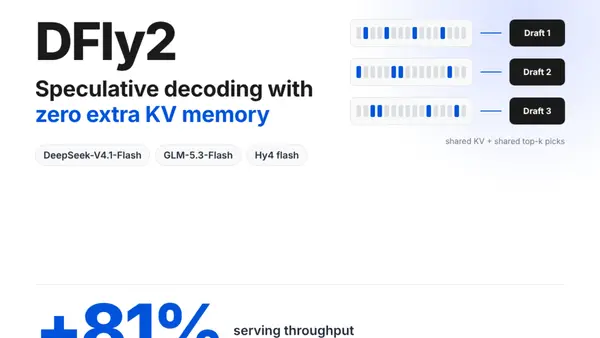
Tencent open-sources DFly2 to speed up sparse-attention LLM serving
Tencent has open-sourced DFly2, a speculative decoding drafter that reuses a sparse target model's KV cache and indexer picks. Tencent reports up to 81% more throughput on DeepSeek-V4.1-Flash at 64K context.