nexos.ai launches platform putting 200+ models behind one AI gateway
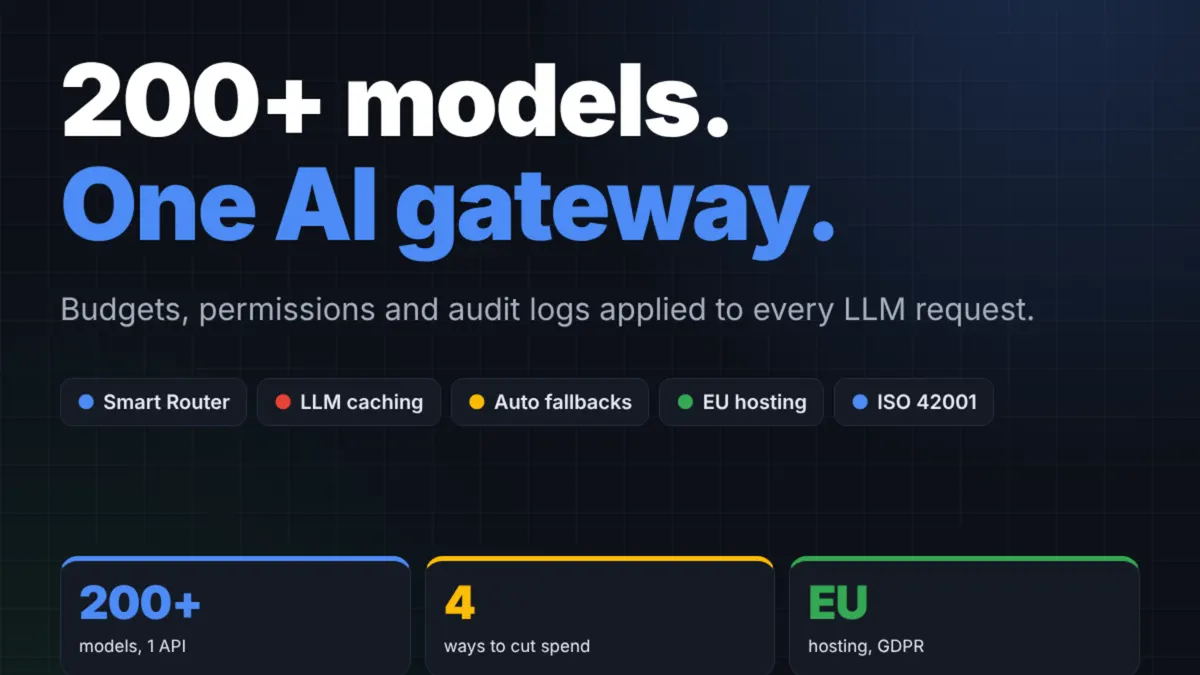
nexos.ai is pitching an AI gateway that routes requests to 200+ models through one API with budgets, policies and audit logs. The piece is sponsored and leans on EU hosting and compliance certifications.
The sprawl problem
Full disclosure first: this one is a sponsored piece from nexos.ai, so read the claims as vendor claims. That said, the problem it describes is real and you've probably met it. Marketing picks one AI tool, engineering picks another, and every team signs up for its own API keys. Spend grows faster than anyone's view of it, and leadership finds out the total when the monthly invoice lands.
What a gateway does
nexos.ai's answer is an AI gateway that sits between your applications and the model providers they call. Developers keep one API and their existing SDKs. Admins get one place to set and enforce rules. The same endpoint reaches 200+ models, which the vendor pitches as a way to adopt new models without locking into one provider. If you've ever written a thin wrapper to swap model vendors, you know the shape of the idea.
Governance
On the governance side, admins decide which teams and users can reach which models, and they set budgets and usage limits per team or user. Policy enforcement applies to every request, with audit logs and traces recording each one. Usage is visible by team and project, so when finance or an auditor asks who used what, the answer is in the logs. SSO and RBAC are listed for access control. The platform also ships Chat & Agents, where employees chat with models and build no-code agents under the same permissions and budgets.
Where the savings come from
The cost features are where builders should look hardest. There's a Smart Router that picks a model per request on cost, quality and latency, so routine workloads stop hitting premium models. LLM caching means identical requests aren't paid for twice. Context compression sends fewer tokens to the model. Cost tracking attributes spend in real time to a team, project or user, down to the request. The vendor says none of this needs changes to your applications. Nothing in the source says how the router decides what counts as routine, and that's the part I'd poke at first.
Reliability gets one line: when a provider goes down or slows, automatic fallbacks reroute requests to another model or provider. That's useful, but test it. A fallback to a different model can change output quality, and the article doesn't say how you control that.
Compliance details
For the compliance crowd, nexos.ai lists SOC 2 Type 2, ISO 27001 and ISO 42001 certifications, plus full GDPR compliance. The platform and most available models are hosted in Europe. Zero data retention is available for supported models, and your data isn't used for training unless you allow it. The pitch ties this to the EU AI Act, which pushes governance from policy documents into daily operations. Note the qualifiers: 'most' models are European-hosted and zero retention applies to 'supported' ones.
Before you book a demo
Getting started means a 30-minute technical demo, after which a Solutions Engineer tailors the setup. Before you book it, the article suggests four checks on your current stack. Can you see AI spend by team and project? Can you enforce model access centrally? Can you show auditors your certifications and logs? Can your apps keep running when a provider fails? Those are good questions whether or not you buy anything. Answer them honestly and you'll know if a gateway is your problem or just a spreadsheet away from solved.
We like the four self-check questions more than the product pitch. If you can't answer them today, a gateway of some kind is worth a look, whether this one or another. Since the source is sponsored, we'd want to test the Smart Router and the fallback behaviour on real traffic before trusting the savings. Watch for output quality shifts when requests get rerouted.
- 01One API and existing SDKs reach 200+ models through a central gateway.
- 02Controls include per-team budgets, model access rules, audit logs and SSO/RBAC.
- 03Savings features: Smart Router, LLM caching, context compression and real-time cost attribution.
- 04Claims SOC 2 Type 2, ISO 27001, ISO 42001 and GDPR compliance with mostly European hosting.
Teams that let each department pick its own AI tools lose track of spend, data flow and accountability. A central gateway is one way to get that control back without rewriting applications.
+Talk about your use caseRead the original
↗MarkTechPostSummary written by Neuvilabs from public reporting. Facts belong to the original sources linked above.
 ToolsBuilder's Notes
OpenAI is building 'Athena' to make data agents more accurate
OpenAI is reportedly building a data platform called "Athena" that works like a semantic layer, giving its agents consistent business metric definitions. It's early, with no timeline or pricing announced.
 PolicySecond Look
Nvidia pauses server shipments to Southeast Asia as US tightens chip curbs
Nvidia has reportedly told Dell, Super Micro and other partners to pause server shipments to Malaysia, Singapore, Thailand and Indonesia while it checks export compliance. The reasons are plausible, but the report offers no evidence of violations and no end date.
 IndustryMarket Watch
OpenAI countersues Apple over trade secrets and pressure on suppliers
OpenAI has countersued Apple in California, alleging trade secret theft and coercion of shared suppliers. It follows Apple's own summer lawsuit over leaks and comes as OpenAI prepares devices to compete with the iPhone.