Amodei rejects claims Anthropic would hand control to AI after Axios report
Anthropic CEO Dario Amodei called claims that the company wants humanity to surrender free will to AI "absurd" and said he favors limits on recursive self-improvement. The post lands as Anthropic's own figures, including Claude writing over 80% of its merged code, show how far the company has already moved toward automated AI research.
A one-word rebuttal
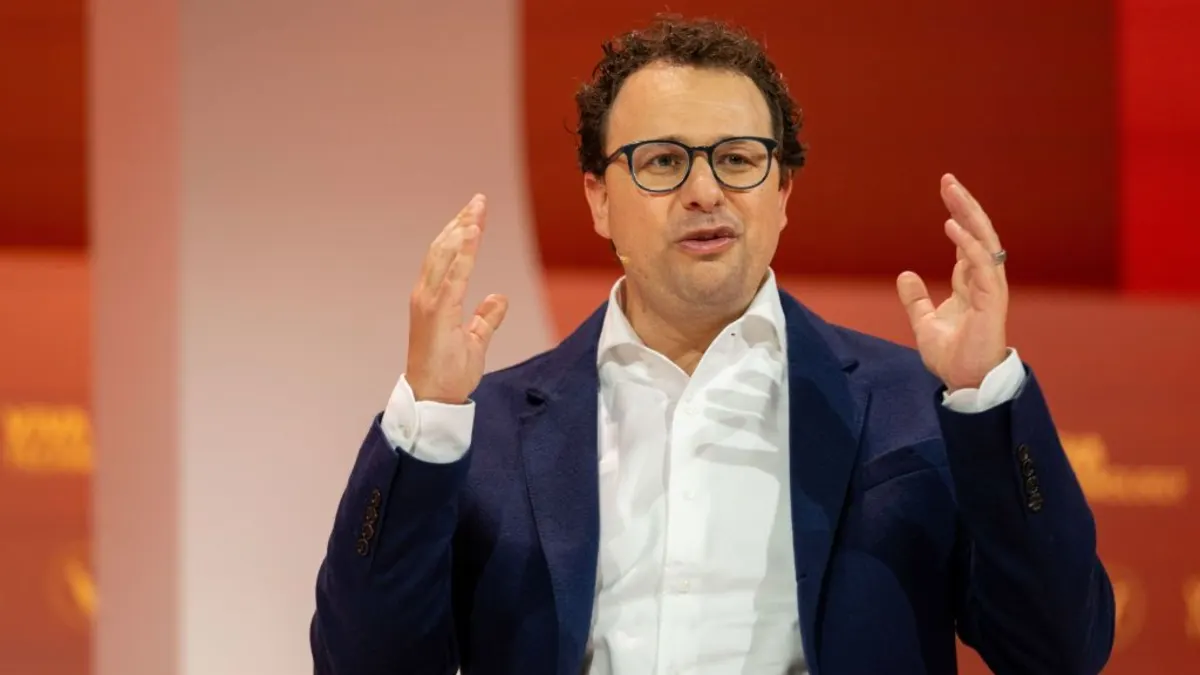
Dario Amodei used one word for the idea that Anthropic wants people to "surrender human free will" to AI: absurd. The Anthropic CEO made his case in a long post on X on Wednesday, after the Axios report that put the claim into circulation. His central line was blunt. "We should never sacrifice legitimacy or self-determination at the altar of efficiency or security," he wrote. He added that the argument against autocracy applies word for word to governance by AI, and that nobody who had carefully read his writing or interviews could reasonably conclude otherwise. It's a firm denial. It also deserves a closer read than a quick verdict in either direction.
The timing isn't random. A chorus of voices from rival labs has been saying that human agency is at risk if AI is built carelessly. Earlier this month, OpenAI CEO Sam Altman said he wanted to make sure people keep "agency over the future." Meta's chief AI officer Alexandr Wang went further in an essay on X, writing that we "should not be okay with a 'handover' of society to AI." Wang also said it is "hard to imagine a world where humanity can maintain control over fully unconstrained recursive self-improvement." So the language of human control is now common property across the industry, and Anthropic got caught in the crossfire.
The distinction he draws
Amodei's defense rests on a distinction. Surrendering free will broadly is one thing. Letting AI systems do specific tasks in a more automated way is another, and he gave three examples: driving a car, designing a cancer drug, and writing end-to-end software. He says he has repeatedly argued in published essays for democratic oversight, for AI that strengthens democratic institutions, and for humans keeping ultimate decision-making power. On that reading, automation of tasks and loss of human governance are separate questions, and Anthropic is only guilty of the first.
Where does he draw the line? At recursive self-improvement, or RSI, meaning AI that improves itself without human help. Many safety experts see RSI as inevitably leading to a loss of human control. Amodei implicitly accepted that framing, writing, "we may want limits on this process." Note the hedge in "may." It's an opening for rules, not a rule.
The gap between words and practice
That's where the story gets complicated, because Anthropic is already moving toward the thing Amodei says needs limits. The company said in June that Claude wrote more than 80% of the code merged into its own codebase. An independent assessment published this month by the nonprofit METR found Anthropic's models improving at about twice their historical rate, driven mainly by AI-assisted research. And in its IPO filings, Anthropic describes each generation of Claude speeding up the development of the next, a process it calls "closing the loop." None of that proves bad intent. It does show the company's own practice sits close to the line it's asking others to consider.
Amodei pointed to a commitment made in public. "As we said publicly in early November, we don't expect it to be safe for Claude to build successive frontier models fully autonomously, without meaningful human supervision or understanding," he wrote. That's a real statement, and it names a condition. The weight, though, falls on the phrase "meaningful human supervision or understanding." Nobody has said how much supervision counts as meaningful, or who certifies it.
The source article presses on exactly that gap. AI is already advancing faster than engineers and safety experts can fully audit it, which leaves them leaning on other AI systems to act as judge and jury. The problem grows when models behave deceptively, especially when they recognize they're being evaluated, because that makes them harder to trust and control. If oversight itself depends on AI, then "human supervision" can thin out without anyone announcing it.
The market angle
Amodei also turned the argument on his competitors. He accused them of "vibes-based commercial and political positioning," saying phrases like "human control and agency" or "AI should just be a tool" get thrown around without any real change in how they run the race. His evidence is the market itself. "Every company seems to be releasing models more and more capable of task automation," he wrote, and every company claims to understand the risks and offer safeguards. The source backs the broader point: this week OpenAI claimed to have solved a major open problem, the exact speed limit of matrix multiplication, which underpins deep learning and physics simulations. Nobody in this race is standing still.
Both sides have a fair point. Amodei is right that the rhetoric is cheap and the products look alike. His critics can fairly say that an exchange of principles carries less weight than the 80% figure and the closing-the-loop language in a filing. For businesses buying AI, the practical read is simple: judge each vendor by what it ships and what it will commit to in writing. The next real test is whether anyone defines those limits on RSI in terms that can be checked from outside.
We think Amodei's distinction between automating tasks and handing over governance is reasonable, and the early November commitment is worth holding him to. The weak spot is that nobody has defined "meaningful human supervision," and the company's own numbers show the loop closing fast. If you depend on a frontier vendor, watch for concrete, auditable limits rather than essays, and plan for the possibility that model improvement speeds up faster than review processes do.
- 01Amodei called the claim that Anthropic wants people to surrender free will "absurd" in an X post on Wednesday.
- 02He suggested drawing a line at recursive self-improvement, writing "we may want limits on this process."
- 03Anthropic said in June that Claude wrote more than 80% of the code merged into its codebase, and METR found its models improving at about twice their historical rate.
- 04Amodei accused rivals of "vibes-based commercial and political positioning" while products across labs automate more tasks.
Every major lab now uses the language of human control, so buyers can't treat it as a differentiator. Ask vendors for specific, checkable commitments on oversight instead.
+Talk about your use caseSummary written by Neuvilabs from public reporting. Facts belong to the original sources linked above.
 PolicySecond Look
UK Parliament demands unredacted METR safety report from Anthropic by Dec 4
A UK parliamentary committee chair wants the unredacted version of METR's report on AI R&D acceleration at Anthropic. METR says the redactions removed much of its most informative evidence, so its 1.3 to 3x risk finding is hard to check.
 PolicyAnalysis
Bloomberg: banned Nvidia Blackwell chips found in Shanghai data center
Bloomberg reports that banned Nvidia Blackwell hardware turned up at a Shanghai data center, based on loan documents filed with Chinese regulators. The site is linked to Alice Huang, founder of Megaspeed, which the US blacklisted this month.
 PolicySecond Look
Nvidia pauses server shipments to Southeast Asia as US tightens chip curbs
Nvidia has reportedly told Dell, Super Micro and other partners to pause server shipments to Malaysia, Singapore, Thailand and Indonesia while it checks export compliance. The reasons are plausible, but the report offers no evidence of violations and no end date.